


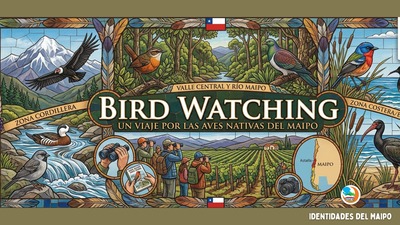
Birdwatching in Chile’s Central Andes
Chile is an outstanding country for birdwatching and is home to 80% of the world´s ecosystems. The diversity of landscapes found throughout the country provides a wide variety of habitats for species eagerly sought by birdwatchers and ornithologists. The high-Andean lakes, grasslands, and mountains of central Chile are home to more than 100 species associated exclusively with high-altitude habitats.
Chile: a world-class birdwatching destination
Chile is well known as a country visited primarily for its stunning natural landscapes and iconic species. Mountaineering, hiking, and nature photography expeditions are not the only activities attracting tourists. The 581 bird species reported throughout Chile also draw birding enthusiasts from around the world.
Many visitors who seek to spot emblematic birds featured in birding guides, documentaries, and nature photography choose Chile as their next birding destination. The mainland, characterized by the Atacama Desert, the Andes Mountains, sclerophyllous forests, and temperate rainforests, offers diverse habitats for birds. The Pacific coast, influenced by the Humboldt Current, is also home to migratory, pelagic, and austral species. Together, these environments attract thousands of birdwatchers, nature lovers, conservationists, researchers, and professional photographers each year.
High level of endemism
Chile has a high level of endemism among avian species due to its geographical isolation between the Andes Mountains to the east and the Pacific Ocean to the west. The country is also home to some of the world’s most southerly bird species, including the endemic Slender-billed Parakeet (Enicognathus leptorhynchus), Magellanic Woodpecker (Campephilus magellanicus), and Black-throated Huet-huet (Pteroptochos tarnii).


Northern Chile is a paradise for observing and searching for rare species. In July 2026, the first White Monjita and Sharp-shinned Hawk individuals were reported in the country. Birders from all regions of Chile travelled to the Arica y Parinacota Region in hopes of finding these exceptional birds.
Chile’s coastline and Pacific Ocean territory are seasonal homes to some of the world’s longest-distance migratory bird species, including the Red Knot and Hudsonian Whimbrel. Year-round pelagic tours are available to observe albatrosses and storm-petrels. This combination of diverse habitats and unique bird species makes Chile one of the best destinations for birdwatchers seeking to observe the most iconic species of the Southern Cone, including some found nowhere else in the world.
Why Birdwatching in the Central Andes Is Unique
The Andes Mountains, a culturally and naturally rich geographical feature, are one of the best habitats for encountering high-altitude wildlife species, ranging from mammals to invertebrates. The mountain range surrounding Santiago is a preferred hotspot for birdwatchers because it provides a completely different ecoregion and, therefore, an exceptional potential species list within a relatively short distance.
Visitors can experience a dramatic change in landscape, from Mediterranean foothills to mountain environments. This transition allows them to observe species that are rarely found elsewhere in central Chile. As observers gain altitude, following the habitat transition from sclerophyllous forests to the High-Andean steppe, species adapted to these high-elevation conditions begin to replace those of the lower slopes. This gradual change between habitats makes every increase in elevation an opportunity to encounter a different bird community.
Additionally, altitude “markers” provide observers with the possibility of identifying similar species through a process of elimination. Birdwatching in this ecoregion is highly connected to the ability to read the landscape, creating a unique and immersive experience. Rather than simply searching for birds, observers learn to interpret changes in elevation and habitat. This is an essential skill for birders looking to specialise in mountain birdwatching.
Birdwatching Locations
El Yeso Dam (Embalse del Yeso), located at 2,500 m a.s.l. (8,200 ft), is one of the most accessible High-Andean birdwatching locations near Santiago. It is also one of central Chile’s most recognized eBird hotspots. The reservoir is surrounded by rocky slopes, offering excellent opportunities to spot birds of prey. The nearby Yeso River is frequented by pairs and families of Torrent Ducks (Merganetta armata).
Although observing waterbirds at this location is possible, high-altitude specialists such as ground-tyrants and sierra-finches are among the most frequently observed species. Many species associated with high-altitude wetlands can be found around the reservoir.

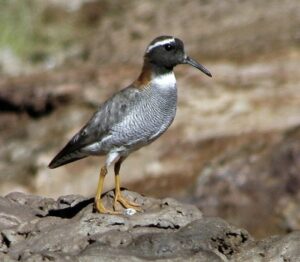
El Morado National Monument (1,750 m a.s.l. / 5,741 ft) is a protected area that preserves untouched High-Andean ecosystems and a stunning diversity of flora that thrives only in high- elevation soils. At this location, habitats range from streams and wetlands to scree slopes and vast grasslands. Home to the striking Diademed sandpiper-plover, El Morado is one of the best places to experience birdwatching near the city. The area has clear trails and is surrounded by unique biodiversity.
Mirador de Cóndores (2,031 m a.s.l. / 6,663 ft) is one of the most visited viewpoints in Cajón del Maipo for observing the majestic Andean Condor in its natural environment. Located among steep mountain cliffs, this area provides ideal conditions for watching condors take advantage of thermal air currents as they soar above the valley and display characteristic behaviours.
The rocky slopes around the viewpoint and along the trail also support other raptors, such as the Variable Hawk. Mirador de Cóndores offers visitors a unique perspective of the Andes beyond its exceptional birdwatching opportunities. Its accessibility makes it ideal for birders seeking to find Chile’s most iconic bird without undertaking a demanding high-mountain expedition.
Birdlife of the Central Andes: What to expect when birdwatching
If you are a birder looking to add unique birds to your life list, the mountains surrounding Santiago offer the opportunity to observe birds adapted to life at high altitudes. Another important point to consider is that a significant portion of Chile’s protected areas and nature sanctuaries are located in the Cordilleran region. These conservation initiatives have supported the reproduction and population stability of several mountain species for years. Because of these combined efforts, birdwatching in this area also provides excellent opportunities to observe reptiles, insects, and amphibians.
High-Andean Specialists
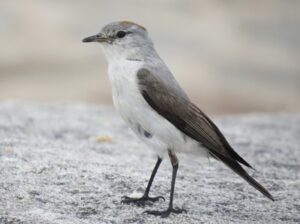
The Mountain Caracara is one of the first species that comes to mind when birdwatching in this area. As its common name suggests, this caracara is highly adapted to life in the highlands of Chile. Another group of birds that birdwatchers are almost certain to encounter are the Ground- Tyrants. Eight of the ten species present in Chile can be found in the mountain habitats of the valleys in Cajón del Maipo. The Cinereous Ground-tyrant, Rufous-naped Ground-Tyrant, and White-browed Ground-Tyrant are among the most commonly seen species in the area.
The Rufous-banded Miner is also fairly common and is often found alongside Ground-Tyrants, as both species favour rocky habitats. Yellow-rumped Siskins are among the most visually striking birds of the region and can often be seen in large flocks in High-Andean grasslands near riverbeds. Other characteristic species of these habitats include the Grey-breasted Seedsnipe, White-sided Hillstar, and Straight-billed Earthcreeper.
Waterbirds of high elevation habitats
The high-Andean wetlands, lakes, and alpine water reservoirs provide essential resting, feeding, and breeding habitats for a great diversity of Andean waterfowl species. These fragile
ecosystems support species that are specially adapted to life at high elevations, and closely associated with freshwater environments at the same time. Among the most characteristic waterfowl are the Upland Goose (Chloephaga picta), the Andean Goose (Oressochen melanopterus), the Crested Duck (Lophonetta specularioides), and the Andean Duck (Oxyura ferruginea). Visitors may observe these birds resting or foraging along the shores of lagoons and wetlands.

Birds found in Pre-Andean Valleys
The pre-Andean valleys create a transition zone between the central Chilean lowlands and the High Andes, supporting a rich variety of native birdlife in sclerophyllous habitats. Slopes, native shrublands, riverbanks, and even cultivated landscapes provide ideal environments for many endemic and highland species that can be easily differentiated and identified by sound or field marks. Among the birds that visitors may encounter is the Black-winged Ground Dove (Metriopelia melanoptera), which is often found in large groups. The world’s largest hummingbird, the Giant Hummingbird (Patagona gigas), is also a frequent species in these shrublands. As mentioned before, endemic species such as the Moustached Turca (Pteroptochos megapodius) inhabit this zone. This is also one of the best habitats to encounter and observe the Chilean Flicker (Colaptes pitius), especially during its yearly reproductive period.
Signature Species
The Black-chested Buzzard-Eagle (Geranoaetus melanoleucus) is a spectacular raptor of the region and one of the most admired species by locals. Frequently observed soaring above valleys and mountain ridges, it hunts mammals, reptiles, and birds with remarkable precision. Its easily recognisable triangular silhouette, short tail, and striking bluish plumage make it one of the most distinctive birds of prey in the Andean landscape. Mountain Parakeets (Psilopsiagon aurifrons) are highly sought after by birdwatchers specialising in psittacines. These bright green parrots are often seen flying in flocks across valleys or feeding on seeds, fruits, and buds. They are small, highly social, and very vocal.

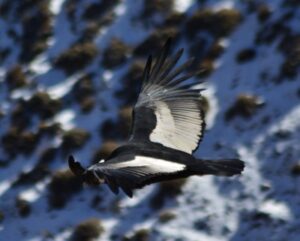
The Crag Chilia (Ochetorhynchus melanurus) is also one of the most memorable birds of the area. It is a specialist of rocky environments, where it searches for insects among crevices and cliffs. Although elusive, this active species, locally known as Chiricoca, is a favourite among experienced birdwatchers because of its specialised habitat and eye-catching behaviour. One of the most impressive and iconic species of the Andes is the Andean Condor (Vultur gryphus), one of the largest flying birds in the world. This scavenger, with a wingspan of more than 3 metres, is often seen searching for carrion across vast distances. The Condor is a cultural symbol of the Andes and holds great symbolic significance throughout South America.
Birdwatching in Chile: Identifying local species
Chile’s birds have evolved with the landscape for decades, and this influences the birdwatching experience observers have during their stay in the country. Beginner observers and those new to this practice for wildlife appreciation, will be benefited by the looks of several Chilean bird species. The variety of landscapes through the country have provided birds with very distinctive features that will allow beginners to practice the art of identifying birds. Many local species have a unique silhouette, colour, or sound that makes identifying them much easier for most observers.
The more experienced birders looking to deepen their bird identification skills will also find good practice in the country, particularly during the warmer months. Those looking for a challenge will often turn to “Field marks” or Marcas de Campo. These clues in a bird´s appearance allow birders to differentiate extremely similar birds by looking for specific features. Among some local bird families, such as the Cinclodes or Shrike-tyrants, identifying the correct species can be hard due to minimal differences. Chile is also an ideal country for birders to master the identification of juvenile hawks, as juvenile Harris’s hawks and Variable hawks look and behave very similarly. Females of mountain Finch species can also look exactly the same, encouraging observers to take guesses and resort to local knowledge.
Responsible and Safe Birdwatching
Birdwatching is one of the best ways to understand the rich biodiversity of Chile and the Andes while also developing a deeper appreciation for its ecosystems. By following responsible birding practices, visitors can help ensure that birdlife remains undisturbed and that these fragile habitats are protected.
During spring and summer, birdwatchers are very likely to encounter or accidentally approach active reproductive sites. Always observe birds from a respectful distance and avoid getting close to breeding areas, whether birds are present or not. Binoculars and spotting scopes not only allow birders to get excellent views for identification, but also have a secondary purpose of avoiding unnecessary disturbance to wildlife. If a bird changes its behaviour, calls repeatedly, or appears agitated, moving away is the best option. Visitors should be aware that playback is highly discouraged amongst the birding community in Chile, especially during spring. Feeding wild birds or any wildlife is illegal in many sites and national protected areas and should not be done, even outside of them.
Leave no trace of your visit by taking all litter with you, avoiding damage to plants, and respecting local regulations and protected areas. Supporting local guides, community-based
tourism initiatives, and conservation programmes also contributes to the long-term protection of the region's natural heritage. Responsible birdwatching enhances the experience for visitors, ensures that these landscapes continue to serve as habitat for native wildlife, and helps conserve the extraordinary birdlife of the Andes.