
National Parks Chile
Protected and Sacred Territories in the South of the World
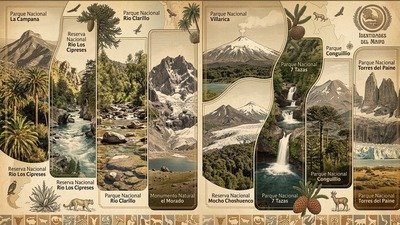
Chile’s 46 National Parks are home to natural wonders of scientific and tourist interest found nowhere else in the world. Ancient temperate rainforests, active volcanoes, and protected ice fields are part of the diverse landscapes of these reserves. Chile’s national parks have been designed to allow visitors to fully enjoy each landscape through classic outdoor activities such as hiking, mountaineering, and wildlife watching. In this article, we will highlight 9 parks that are part of Chile’s network of protected areas. Visitors should consider their physical fitness, budget, and schedule when choosing a destination to ensure the best experience possible. National Parks Chile are of tremendous ecological and cultural importance. We encourage visitors to leave no trace and to report behaviors that may put these places in danger.
Conguillío: A prehistoric landscape in National Parks Chile:
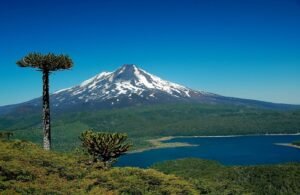
One of the country’s most pristine ecosystems is found in Conguillío National Park. Located in the eastern part of Chile’s Araucanía Region, on the slopes of the Llaima volcano. The ancient Araucaria forests (Araucaria araucana) are the main attraction of this park, which also features a glacial lake and offers views of the active volcano. Conguillío comes from “Ko-nqilliu,” which in the Mapuche language means “pine nuts in the water.” The absence of grasslands in Conguillío confirms that it was once inhabited by dinosaurs, for this reason, it was chosen to film part of the BBC series “Walking with Dinosaurs.” This park has campsites, who are a great option for visitors looking to spend the night and carry out astronomic viewing activities. Birdwatchers also frequent this park, as it is one of the best places in Chile to spot the large and emblematic Magellanic woodpecker (Campephilus magellanicus).
Tourists can hike up the Sierra Nevada trail, a volcanic mountain range offering views to the source of the Blanco River, Lake Conguillío, and the Llaima Volcano.
Along the Los Carpinteros trail, you will find the “Madre Araucaria” (Mother Araucaria), an individual that is between 600 and 1.800 years old. It is recommended to visit this park during the summer months (December to March) to enjoy stable weather and trails free of snow. Fall is a season well worth photographing at this national park, as the native Lenga and Ñirre trees turn beautiful reddish-orange hues. Other activities include boating on Lake Conguillío in boats rented from the park administration or fishing with a valid fishing license.
Torres del Paine: The Icon of Chile’s National Parks
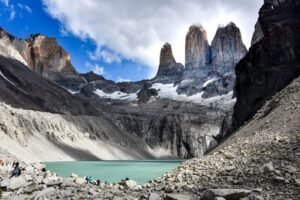
Images of Torres del Paine are the first to appear when searching for national park destinations in Chile. This is the favorite spot for foreign tourists and local adventurers alike. This natural wonder, one of Chile’s most important protected areas, is located in the Magallanes Region and was originally inhabited by the Tehuelche people. The park’s wildlife is diverse, the easiest animals to spot are guanacos, which travel in large herds. There are also other native mammals, such as culpeo foxes and chillas, armadillos, and the majestic Southern Huemul.
Strong winds blow year-round in Torres del Paine National Park Chile, reaching speeds of up to 150 km/h, so it is recommended that visitors wear appropriate clothing. Planning ahead will allow visitors to enjoy the trails, which include multi-day hikes such as the popular W Circuit, featuring viewpoints overlooking glaciers and lakes. The O Circuit is a good challenge for those seeking a trek around the entire Paine Massif and excellent views of the Grey Glacier. It’s worth spending about 5 days in Torres del Paine to get a full and enjoyable experience of one of the most remote places in the world.
Río Clarillo: National Parks Chile
Are you interested in visiting a national park during your stay in the capital? If you’re short on time, Río Clarillo is your best option. About 45 minutes from downtown Santiago you will find one of Chile’s most recently designated national parks.
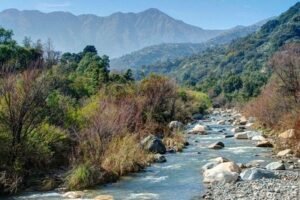
This national park is home to one of the country’s most important ecosystems, the sclerophyllous forest, and is an excellent choice for families looking for day hikes. Río Clarillo features flora species adapted to prolonged droughts, such as the peumo, quillay, espino, litre, lingue, canelo, and naranjillo. Some trails available in this park are Quebrada Jorquera Trail, which is covered by native forest offering good shade that attracts insects and birds, and Sendero de los Bueyes. This last trail is of moderate difficulty and ideal for experienced hikers looking for panoramic views.
The park is home to the Clarillo River, which originates in the westernmost foothills of the Andes Mountains, at the confluence of the Maitén and Cipreses streams. If you are visiting during the summer months, we recommend checking out this park, as the crystal-clear waters of the Clarillo River are perfect for swimming. This National Park has picnic areas that will allow visitors to enjoy meals during half or full day visits, it is important to remember that feeding wildlife is prohibited.
El Morado Natural Monument: Glacier viewing and High-Andean wetlands
Although it is not a national park, this high-altitude Andean reserve is one of the best places in Santiago to observe Andean condors flying over their natural habitat. Located in the Cajón del Maipo district, this reserve features vegetation consisting of Andean sclerophyllous shrubland and high-Andean steppe in the Santiago Mountain Range. Its main trail is a 6-km hike to Morales Lagoon, located 2,400 meters above sea level, which offers views of the El Morado hanging glacier. It is very important to keep in mind that any hiking activity must comply with certain rules and restrictions and will require appropriate gear for the season.
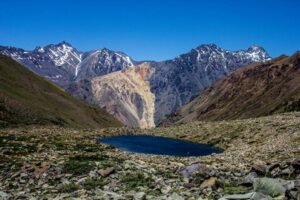
El Morado is not only protected for its high- Andean wetlands, which are home to wildlife species adapted to high altitudes, but it is also one of the few sites in Chile protected for its geological significance. Some of the geological features of this reserve include active and retreating glaciers, fluvioglacial deposits, and fossils dating back more than 140 million years. In the El Morado Natural Monument, you can also find rocks belonging to important formations such as Lo Valdés, Abanico, and Colimapu. If you’re interested in mountain flora, we recommend visiting this reserve, as it is home to rare and endangered species, such as the Pink Mountain Lily (Alstroemeria umbellata).
Siete Tazas National Parks Chile: Unique shaped waterfalls and volcanic history
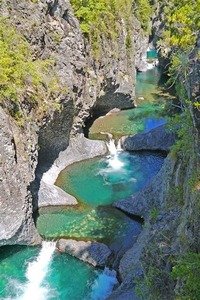
This unique and popular park is located in the Maule Region. It is open all year and the peak visiting season is the summer months, from December through March. This protected area is dominated by the Maule high-Andean steppe and deciduous forest, consisting of species native to Chile such as Oak, Raulí, ÑIrre, and Hualo. Siete Tazas, meaning “seven cups”, gets its name from a string of turquoise pools that the Claro River has carved out of the area’s volcanic rock. Each pool is connected to the next by small cascading waterfalls.
This park has a limited daily capacity, therefore registration and planning should happen in advance as many travelers driving south choose this National Park as a stop. In the El Bolsón area, there is a rock formation known as Colmillo del Diablo, nearly 500 meters tall, which rises above the surrounding plain. This trail is part of the Cóndores Circuit, which connects Radal Siete Tazas National Park with the Altos de Lircay National Reserve. And of course, the Claro River is the most scenic attraction at this must-visit National Park, as well as its 1,500 endemic flora and fauna species.
Villarica National Park: Perfect for volcano lovers
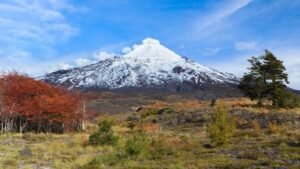
Villarica National Park extends across the Araucania and Los Ríos regions. It is of great ecological importance and for that reason, It is part of the Southern Andes Temperate Rainforests Biosphere Reserve. The park features a camping area and ski resort during the summer months. Other attractions offered to visitors include visits to craters and caverns. The park is home to the Villarrica (2,847 m above sea level), Quetrupillán (2,360 m above sea level), and Lanín (3,776 m above sea level) volcanoes.
Are you looking for a mountaineering experience? Villarica National Park offers magnificent ascent opportunities with local guides who provide expertise and adequate technical equipment according to weather. This park will provide you with the opportunity of reaching the Villarica Volcano’s crater during a 7-hour ascent, this expedition is fit for anyone with a good fitness level. This unique experience at one of South America’s most active volcanoes is perfect for those aiming for a more adventurous and exciting National Park visit.
La Campana National Parks Chile: Visited by Charles Darwin
Located in the Valparaiso region, this emblematic park has been designated by UNESCO, together with the Lake Peñuelas area, as a biosphere reserve. This National Park is full of secrets and hidden areas. Aside from the Sendero del Andinista, the El Guanaco circuit, and La Cascada, there are other lesser-known paths that lead to unexplored places. Such as the Las Palmas Trail, which goes through the Quebrada de Los Ángeles, an area of humid hygrophilous forest. A landscape from this park is featured on the 5000 Chilean peso bill. We recommend that those interested in observing, photographing, or learning about the Chilean palm in all its beauty follow the “El Amasijo Trail” in the Ocoa area through the densest palm grove to the Ocoa Pass. The population of Chilean Palm present in this park surprised Charles Darwin during his expedition to La Campana Hill in 1834.
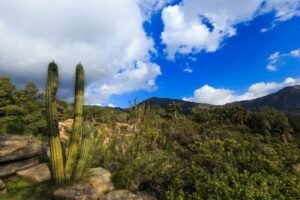
This Park is a top choice for natural history and botany lovers. Also is home to one of the last large Chilean palm forests in the country, an endemic and endangered palm species. This park represents up to 20% of the plant species found throughout Chile, and hosts a large population of the native mammal Degú (Octodon degus).
Río los Cipreses National Reserve: A landscape of Parrots and Rivers
This National Reserve is located in the Andes Mountains. The bottom of this valley, accessed by a narrow trail suitable for mules or horses, takes visitors to the source of the Cipreses River. This river once flowed from the Cipreses Glacier at the head of the valley. Río de Los Cipreses features six hiking trails of varying difficulty for visitors to explore, including one that is wheelchair accessible. The reserve also has areas open to the public, but camping and lighting fires with charcoal or firewood are not permitted.
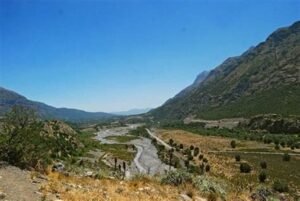
Its relative closeness to Rancagua and Santiago makes it convenient to plan a one or two day visit. It can be accessed via La Carretera del Cobre and La Ruta del Ácido. The Birdlife at this National Reserve is one to highlight and appreciate. This is one of the reproduction sites for Chile’s largest parrot species, the Burrowing parrot belonging to the bloxami subspecies. This big and colourful parrot nests in carved cavities and is in danger because of illegal keeping and trafficking. Another signature species at Río los Cipreses National reserve are the elusive Torrent ducks, that can be found swimming against the river´s current.
Mocho Choshuenco National Park: Valdivian forests by the Volcano
The Mocho Choshuenco National Reserve is located in the Los Ríos Region and was created in 1995. It is located within the Huilo Huilo and Seven Lakes tourist destinations, making it a perfect addition to your destination list. The reserve is renowned for its role in protecting Andean wildlife species, including mammals such as the Puma, Chilla fox, and Pudú, and birds such as the Black-chested buzzard eagle and the Magellanic woodpecker. Those interested in climbing above 1,500 meters above sea level and reaching Mocho-Choshuenco Volcano summit must “declare” their intention at the entrance, register, and must have verifiable mountaineering experience.
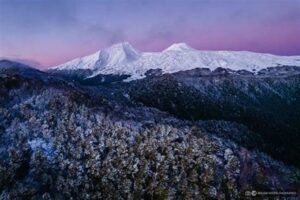
The only way to reach it is 180 km from Valdivia, and 74 km northeast of the city of Panguipulli, passing through Choshuenco and Chanchan before finally reaching Enco. If high altitude expeditions are not your cup of tea, you can enjoy activities such as rafting, river kayaking and kayaking excursions, horseback riding, traditional cuisine, ethnotourism and wildlife spotting. For shorter hikes, there are trails that lead to overlooks with views of Lakes Riñihue and Panguipulli. Visitors should note that During the winter season, the only designated parking area is along the road at km 11, and the only open trail is the Afquintue Trail.
Welcome to Chile’s National Parks
Natural landscapes aren’t the only attraction in Chile’s national parks; many tourists visit these parks to better understand the extraordinary worldview of the Mapuche people. Mapuche tradition is directly linked to the territory’s diverse geographical features. It is undeniable that ther ichness of Chile’s national parks goes far beyond the breathtaking landscapes that stretch from the central region to Patagonia.
We reiterate that following the rules in parks helps us preserve these natural spaces, which are home to countless species of native and endemic wildlife. Reporting behaviours that put our National Parks at risk to the administration is a visitor’s responsibility and might help prevent disasters such as wildfires. Whether you’re interested in Chile’s geological history, or want to experience backpacking through the south, there is a national park that will fit your travel plans.
Welcome to the South of the world!